SME Automation Robotics: When the cobot thinks for itself — and pays off
Up to 50 percent less downtime—not through new hardware, but through a robot that understands what humans will do next. A pilot project from Dresden shows what SME automation with robotics looks like today: more efficient, more flexible, and without the full investment risk.
Why SMEs hesitate to automate — and what it costs
Many medium-sized manufacturing companies know that robotics will secure their long-term competitiveness. And yet they hesitate. The reasons are rarely technical: they are the acquisition costs, the dependence on a single supplier, and the uncertainty as to whether the use case will actually pay off.
In addition, there is an operational problem that is often underestimated in everyday practice: Stationary robots stop as soon as a person enters their work area. In a mixed production environment, this happens dozens of times a day. Every stop costs time—and quickly adds up to a serious efficiency problem.
For large companies, this is solvable. For an SME that is just introducing robotics, it can call the entire business model into question.
Cobots as a service: The Dresden pilot project
Within the framework of the Digital Product Factory of the Smart Systems Hub, Infineon Technologies and SAP Germany, together with Wandelbots and adesso, tackled precisely this problem — with a clear mission: a functioning prototype for intelligent human-robot interaction, developed in three months.
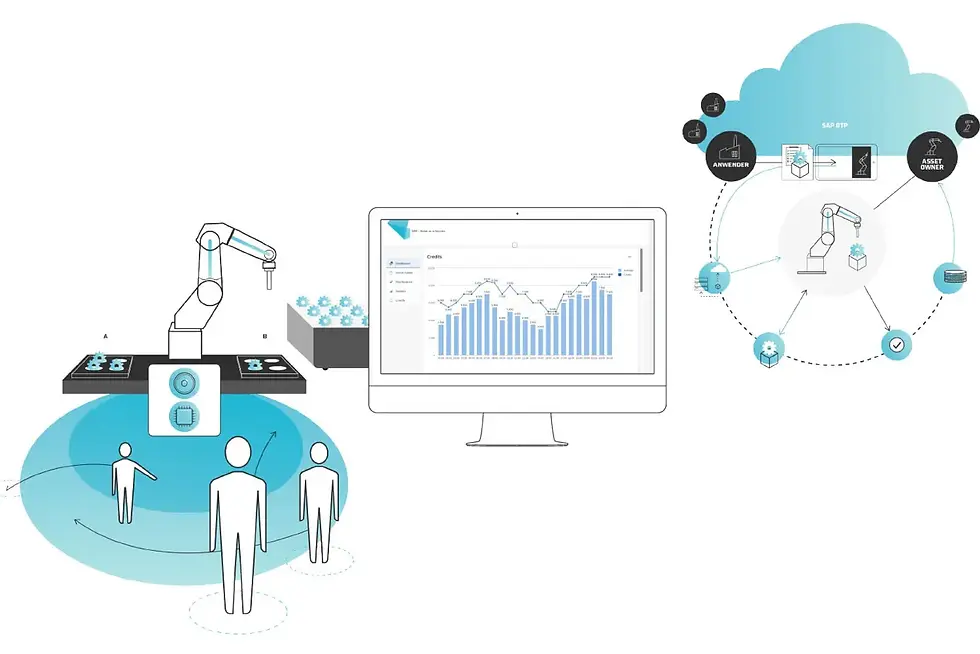
The technical solution is based on AI-supported sensor fusion. Radar and time-of-flight sensors continuously monitor the robot's environment. The data is pre-processed directly on the device (edge computing), analyzed using an AI model, and fed back to the robot controller as action recommendations.
The result: The robot reacts intelligently—it avoids obstacles, slows down, or changes its task. A complete stop becomes the exception, not the rule. The measured reduction in downtime: up to 50 percent.
The real potential: Robotics on a rental basis for SMEs
The efficiency gains are impressive. But what really makes this approach interesting for SME automation is the business model it enables.
The software solution is based on the digital twin concept according to Industry 4.0 standards. It maps every activity of the robot—from task recognition to billing—in real time. This enables precise billing of individual production steps.
Specifically, this means that robots no longer need to be purchased. They can be rented for individual processes or time slots — Robotics-as-a-Service instead of a one-time investment.
For SMEs, this fundamentally changes the calculation:
No high investment volume at the beginning
No excess capacity during periods of low utilization
No vendor lock-in through proprietary hardware
What this means for your automation strategy
This project is not an isolated case. It is proof that the technical and economic infrastructure for scalable SME automation with robotics already exists in Saxony — and that it is accessible from within the network.
The transferable insight: Adaptive robotics not only reduces downtime. It enables business models that open up robotics to companies that were previously excluded.
Next step: Finding the right partners
SME automation with robotics doesn't work in isolation — it needs the right network of technology providers, system integrators and like-minded individuals.
Robot Valley connects manufacturing companies with precisely this ecosystem: directly, without detours, with partners who have already implemented real projects.
Source: Smart Systems Hub — Digital Product Factory #3. Project partners: Infineon Technologies, SAP Germany, Wandelbots, adesso.