What Saxony Can Learn from Guangzhou: Five Takeaways from China's Robotics Market
In early June 2026, a Robot Valley delegation traveled to Guangzhou — to the trade show floor, the conference stage, the factory halls, and the university. We didn't come back with souvenirs. We came back with five observations that matter to every robotics company in Saxony.
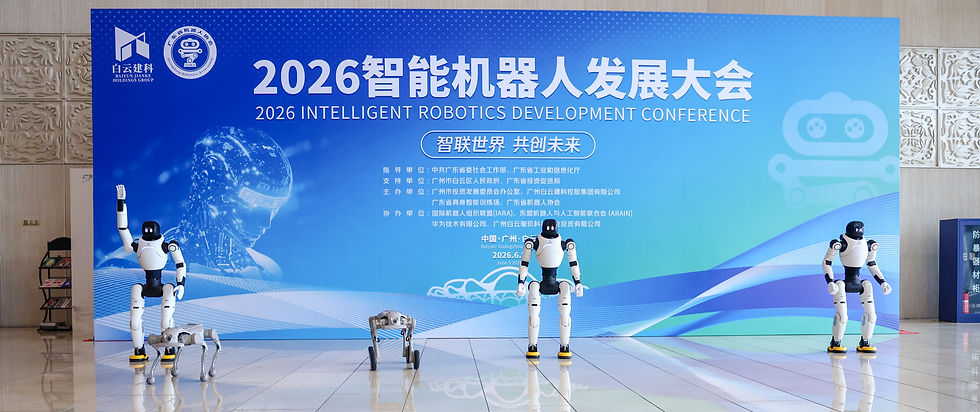
There are two ways to talk about China's robotics market. One runs on numbers, market share, and threat scenarios. The other emerges when you spend a week on the ground, standing in production halls, debating with researchers, and realizing that a lot of it is different from what you expected — and some of it is closer to us than we'd like to admit.
Our delegation trip to Guangzhou began on June 1, 2026. The agenda included the Guangzhou International Intelligent Robotics Exhibition at the Canton Fair Complex, where we shared a joint booth with other companies; the World Robotics Industry High Quality Development Conference at the Baiyun International Convention Center; company visits to Saite Robot and Guonuo Automation; and a meeting with colleagues from the South China University of Technology (SCUT). The AAS professorship, represented by Dennis Bäcker, was also part of the delegation.
Here's what we took away.
1. The competition isn't about individual products. It's about ecosystems.
One of the most heavily discussed topics at the World Robotics Industry Conference was "Environment and Ecosystems" — and it wasn't conference-speak. The conversations were concrete: how robotics works across industry boundaries, moving from industrial to service applications, from logistics into care, from research into deployment.
What this means for us: Competing internationally isn't about selling a robot. It's about belonging to a working network of hardware, software, integrators, end users, and research. That's exactly why clusters like Robot Valley exist — and why "Who do I work with?" has become a more strategic question than "What do I build?"
2. Embodied intelligence is no longer a vision. It's a development agenda.
The second major conference theme was hybrid intelligence — the interplay between human and machine intelligence. Combined with the embodied intelligence focus that ran through the entire exhibition, the picture is clear: the next round of competition won't be won on mechanics. It will be won on how well a system understands its environment and collaborates with people.
What this means for us: Mechanical precision and engineering quality — classic Saxon strengths — remain necessary but are no longer sufficient on their own. The decisive question is how quickly AI capabilities get integrated into existing robotic systems.
3. Iteration speed beats perfection — at least at the start.
At Saite Robot and Guonuo Automation, we saw very different applications of modern automation technology. What stood out in both cases: the path from prototype to first deployment is short. Systems get into real environments early, learn there, and get refined afterward.
What this means for us: This isn't a call to abandon quality standards — quite the opposite. They're a genuine European differentiator. But it is worth taking an honest look at your own time-to-first-customer. Where does the pursuit of perfection slow us down, and where does it protect us?
4. Access comes from showing up — not from sending emails
The joint booth at the Guangzhou International Intelligent Robotics Exhibition turned out to be exactly what a joint booth should be: a ticket in. Visibility on site, conversations without scheduling, contacts that would never have materialized over a video call. The openness and hospitality of our hosts made those exchanges even more productive.
What this means for us: For small and mid-sized companies, exhibiting alone at a show of this scale is barely feasible. As part of a group, it is. That's the practical value of a delegation trip — it drops the cost barrier to internationalization dramatically.
5. Science is the most durable door opener
Our meeting with academic colleagues at the South China University of Technology was marked by substantive technical exchange and conversations about concrete joint projects. Research partnerships are built on longer horizons than commercial ones, they're less volatile in the face of shifting political conditions, and they create the trust that industrial collaboration can later be built on.
What this means for us: If you want to build international partnerships, don't treat the research layer as a nice-to-have. Treat it as the foundation.
What this means for Saxony
The honest summary: China's robotics market moves fast, thinks in ecosystems as a matter of course, and is investing heavily in embodied intelligence. At the same time, there is real interest in European engineering expertise, in quality standards, and in cooperation — not just competition.
For companies in Saxony, that calls for neither panic nor indifference. It calls for paying attention, staying compatible, and applying our strengths where they actually create differentiation. Guangzhou showed us those doors are open. You just have to walk through them.
What's next
Robot Valley is systematically expanding its collaboration with Chinese partners — through roundtable formats on humanoid robotics and physical AI, and by preparing further joint appearances abroad.
Want to join the next delegation trip, or explore international robotics partnerships? Get in touch — we'll connect you with the right partners.